








How to Cut Curves in Sheet Metal Without Snips, Grinders, or Distortion
If you've ever tried to cut a tight curve into a sheet of aluminum or 14-gauge steel, you already know the drill: tin snips warp the edge, jigsaws chatter and skip, and a cutoff wheel turns the whole panel into a shower of sparks and a wavy mess. There's a cleaner way to do it — and it mounts to the drill that's already in your hand.
This guide walks through exactly how to cut curves in sheet metal using a drill-powered nibbler, why the technique works, and the simple two-rule method we've been teaching contractors for over 35 years.
Why Cutting Curves in Sheet Metal Is Such a Pain
Sheet metal doesn't forgive sloppy tools. Snips bend the surrounding material as the blades close, leaving a rippled edge that's a nightmare to flatten. A jigsaw blade flexes and wanders on tight radii. A cutoff wheel throws sparks into anything flammable nearby and leaves a heat-affected zone that warps thin gauges.
What you actually want is a tool that removes the metal — not crushes it, not melts it — in small, controllable bites. That's exactly what a sheet metal nibbler does.
What a Sheet Metal Nibbler Actually Does
A nibbler punches small crescent-shaped slugs out of the material, one after another, leaving a clean kerf with no distortion on either side of the cut. There's no compression like with snips, no heat like with a grinder, and no blade chatter like with a jigsaw. Just bite, bite, bite — straight through.
The catch with most nibblers is they only cut in a straight line. Try to follow a curve and they bind. That's the problem the Bad Dog Biter was built to solve.
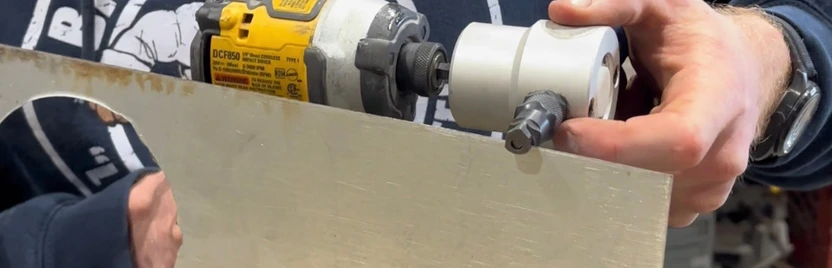
The Biter's patented steerable head pivots from the front of the tool, so you can guide every cut with your thumb. Mount it to any corded or cordless drill, line up your cut, and you've turned a basic drill into a precision sheet metal nibbler that can trace tight radii, cut panel cutouts, and follow curves you couldn't dream of with snips.
How to Cut Curves in Sheet Metal With the Bad Dog Biter
The technique is simple — really just two rules.
1. Keep the tool perpendicular to the material.
This is the single most important habit. The cutting head needs to sit at a true 90° angle to the surface you're working. Tilt the tool and the blade contacts unevenly, dulling the edge fast. Hold it square, let the drill do the work, and the Biter feeds itself through the cut.
2. To steer, loosen the set screw and guide with your thumb.
The cutting head locks straight by default for clean rip-cuts. When you need to follow a curve, loosen the set screw on the front of the head — it's the only set screw you'll touch — and the head pivots freely. Push the front of the head with your thumb to point it where you want to go. Steer the cut like you're steering a tiny snowplow.
That's it. Cut straight by holding perpendicular. Cut curves by loosening the screw and steering. No special technique, no gymnastics.
Quick Reference — Bad Dog Biter Specs
| Capacity | Detail |
|---|---|
| Mild steel | Up to 14 gauge |
| Aluminum | Up to 10 gauge |
| Other materials | Lexan, Formica, plastic, leather, paper, thin wood veneer |
| Drill compatibility | Any corded or cordless drill |
| Blade | HSS, dual-head pass-through design (flip to double life) |
| Weight | Under 1 lb |
| Cutting life | ~2,000 ft per blade set on 18-gauge mild steel |
Pro Tips From the Shop
A few things we've learned across 40+ years of making cutting tools:
Mark your line in pencil or marker, not a scribe. A scribed line in thin metal can act as a stress riser and your cut may wander toward it.
Run your drill at moderate-to-high RPM. The Biter cuts by repeated punching — more RPM means more bites per second and a cleaner edge.
Flip the head when one side dulls. Both heads in the kit are dual-cutting. You get twice the blade life before you ever swap a blade.
Working a deep panel? The standard Biter has a 2" reach. For ductwork and recessed work, the Long Dog Biter gives you 4" of reach with the same steerable head.
Skip the Snips. Cut Cleaner.
The Bad Dog Biter is made in Bristol, Rhode Island by the same family-owned shop that's been building drilling and cutting tools since 1988 — three generations and over 6 million bits later, we still hand-test every tool that leaves the building. Like every Bad Dog tool, the Biter carries our lifetime guarantee — if it breaks, we'll repair or replace it. You only pay return shipping.
Get the Bad Dog Biter
Made in USA. Backed by our lifetime guarantee.
SHOP THE BAD DOG BITER →Questions? Call 800-252-1330 or email topdog@baddogtools.com
Frequently Asked Questions
What is a nibbler tool used for?
A nibbler cuts sheet metal and other thin materials by punching out small slugs along a cut line. It produces a clean, distortion-free edge with no heat, no sparks, and no warping — making it the go-to choice for HVAC ductwork, auto body panels, and custom panel cutouts.
Can you cut curves with a drill nibbler?
Most drill nibblers only cut in a straight line. The Bad Dog Biter is built around a patented steerable cutting head — loosen the set screw on the front and you can guide the head with your thumb to follow any curve, tight radius, or freehand pattern.
What's the thickest metal a Bad Dog Biter can cut?
Up to 14-gauge mild steel and 10-gauge aluminum. It also handles non-metals like Lexan, Formica, plastic, leather, paper, and thin wood veneers.
Do I need a special drill?
No. The Biter mounts in seconds to any standard corded or cordless drill — same chuck setup as a drill bit.
How long does the blade last?
Roughly 2,000 feet of cutting per blade set on 18-gauge mild steel. The dual-head design means you can flip the head to double the working life before you swap blades.
Written by Joseph Strong on 22nd Apr 2026 I’m JJ Strong, a mechanical engineer and third-generation tool designer at Bad Dog Tools, our American-made, family-run company built on durability and innovation. I grew up hauling booths and talking tools at trade shows before I could even drive. Now I design and build and improve our next generation of lifetime-guaranteed tools - our custom induction brazing system to our precision sharpening technology. On weekends, you’ll find me restoring my ’86 Land Rover Defender or ’54 Jaguar XK120 and seeing just how much I can build (or break) with Bad Dog Tools.