









Best Drill Bit for Melamine Without Blowout (It's Not What You'd Expect)
You measured twice. You drilled once. And now there's a blown-out, splintered crater on the back side of your melamine cabinet panel staring back at you.
If you install cabinets for a living, or even just built one for your own kitchen, you know the frustration of drilling melamine without blowout. Those holes don't go away. The shelves go in, the doors go on, and that chipped laminate edge is right there every time someone opens the cabinet. For years. The best drill bit for melamine without blowout isn't a Forstner. It isn't a spade bit. It's something most woodworkers would never think to reach for, and we stumbled onto it almost by accident.
Why Melamine and Laminate Are So Hard to Drill Clean
Melamine and high-pressure laminate are thin, hard, brittle surfaces bonded to a particleboard or MDF core. When a drill bit exits through the back face, the laminate has nowhere to go and it fractures outward. The result is that ragged, chipped-out blowout that makes new cabinets look like they came out of a demolition site.
The two bits most people grab for this job are spade bits and Forstner bits. Both make it worse.
A spade or paddle bit is aggressive by design. It's made to hog through wood fast. When it punches through the back of a melamine panel, it rips the laminate surface with it. The exit hole looks destroyed.
A Forstner bit is a step up in theory. It's a cleaner cutter and leaves a flat-bottomed hole. But on melamine, especially when drilling freehand for shelf pins, it still tends to fracture the laminate on exit and leaves a ragged, oversized mess around the hole. Neither bit was designed to manage that brittle laminate face on the way out.
The Unexpected Fix: A Sheet Metal Bit
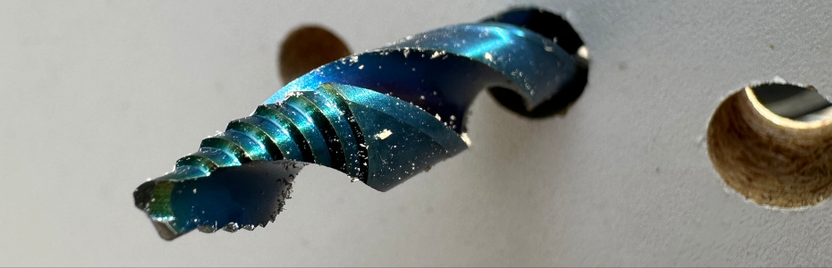
Here's the thing we figured out at Bad Dog Tools: our sheet metal bits, the SMBits, built specifically for drilling steel, aluminum, and other metals, produce a remarkably clean exit hole when you drill through melamine and laminated cabinet panels.
We didn't design them for wood. But the geometry that makes them work on sheet metal turns out to be exactly what melamine needs.
The SMBits have a multistep tip that self-centers on contact and manages the exit point carefully rather than punching through all at once. That controlled, progressive cut through the laminate surface is what prevents the blowout. Instead of forcing through and ripping the face, the bit works its way out clean. The result is a tight, smooth hole. The kind that looks intentional. The kind you want behind every shelf pin.
How to Drill Melamine Without Blowout: Step by Step
- Mark your hole locations. Use a self-centering punch or a sharp pencil point. Accurate placement matters. You only want to drill these once.
- Set your drill speed low. Target around 600 RPM. This is the sweet spot for most cordless drills on a mid-range speed setting. The SMBits are cobalt and built for metal so they don't need brute force to cut through laminate.
- Use light, steady pressure. Let the bit do the work. You're not driving through 2x4 framing. Consistent light pressure produces a cleaner hole and extends bit life.
- Apply cutting oil if you have it. On melamine you can skip it if needed, but a drop of Bad Dog Dried Drool on the tip doesn't hurt and keeps the bit sharper longer.
- Drill straight through in one pass. Don't back out and re-enter. Commit to the hole. The multistep tip manages the exit. Trust it.
- Check the back face. Clean hole, tight edge, no blowout. That's what you're after.
QUICK REFERENCE
| Setting | Value |
|---|---|
| Drill speed | ~600 RPM / low setting on cordless drill |
| Pressure | Light and steady |
| Cutting fluid | Optional on melamine; recommended on metal |
| Impact driver | Feather the trigger — impact guns run ~3,000 RPM |
Other Places This Trick Works
Once you've got the sheet metal bits in your hand, you'll find more uses than you expect. The same clean-hole performance that works on melamine also applies to plastic laminates and solid surface, thin aluminum or composite panels, and PVC and hard plastics, drilling clean without cracking or melting the edge.
For anything harder like concrete, stone, masonry, or hardened tool steel, the SMBits aren't the right call. And for general-purpose drilling through mixed materials (wood, drywall, thin steel in one pass), the original Bad Dog Multipurpose Drill Bit Set is still the go-to.
Get Clean Holes Every Time
14 sizes from 3/32" to 1/2" · Solid cobalt build · 1/4" quick-connect hex shanks · Rugged metal index case
Backed by the Bad Dog Lifetime Guarantee — dull or damage a bit and we'll sharpen or replace it. For life.
Frequently Asked Questions
Can I use a sheet metal bit on melamine cabinet panels?
Yes, and it's one of the cleanest options available for shelf pin holes and other through-holes in melamine or laminate-faced panels. The Bad Dog SMBits have a multistep tip that manages the exit point carefully, which prevents the laminate from fracturing on the back side. Most woodworkers don't think to reach for a sheet metal bit on wood, but the geometry works in your favor here.
Why does my drill bit keep chipping the melamine surface?
Most standard wood-drilling bits like spade bits, paddle bits, and even Forstner bits exit the back face of melamine too aggressively. The thin laminate layer fractures under the pressure of a fast exit. The fix is a bit with a more controlled tip geometry and lower drilling speed. Around 600 RPM with light, steady pressure is the right combination for clean results.
Do I need a special drill bit for laminate cabinets?
You don't need a dedicated "laminate bit" but you do need to choose the right geometry. Bits designed to manage their exit point (like multistep sheet metal bits) outperform standard wood bits on laminate surfaces. Drilling speed matters too: slower RPMs give the laminate face time to be cut rather than torn.
What size drill bit do I need for shelf pin holes?
Most shelf pin systems use either 5mm (~13/64") or 1/4" holes. The Bad Dog 14 Piece Sheet Metal Bit Set includes both 1/4" and sizes on either side, so you're covered for virtually any shelf system. Check your cabinet hardware spec before drilling.
What's the difference between the Bad Dog Sheet Metal Bits and the Multipurpose Drill Bits?
The SMBits are solid cobalt and engineered for metal. They're the right choice when you need clean holes in sheet metal, aluminum, stainless, or laminate panels. The Multipurpose Drill Bits are the original Bad Dog design built for drilling through mixed materials in a single pass like wood, drywall, thin steel, tile, and more. If you're doing cabinet work specifically, the SMBits win on melamine. For everything else on the job site, the Multipurpose set is the workhorse.

Written by Joseph Strong on 27th May 2026 I’m JJ Strong, a mechanical engineer and third-generation tool designer at Bad Dog Tools, our American-made, family-run company built on durability and innovation. I grew up hauling booths and talking tools at trade shows before I could even drive. Now I design and build and improve our next generation of lifetime-guaranteed tools - our custom induction brazing system to our precision sharpening technology. On weekends, you’ll find me restoring my ’86 Land Rover Defender or ’54 Jaguar XK120 and seeing just how much I can build (or break) with Bad Dog Tools.