








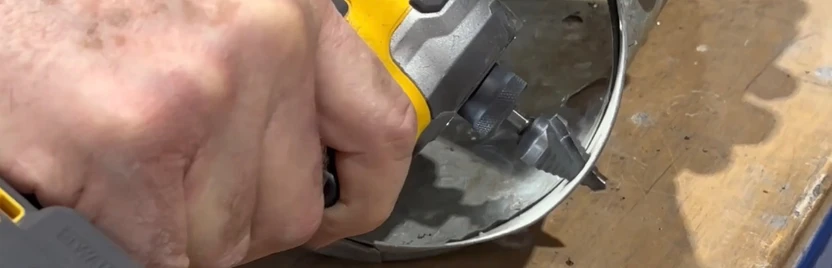
The Short Step Drill Bit Built for Places a Full-Size Bit Won't Go
You've got the hole marked. You've got the bit. What you don't have is room to swing the drill.
Every HVAC tech, collision guy, and maintenance mechanic knows the feeling. A 6-inch step bit sticking out of the chuck like a bayonet, and four inches of clearance to work with. So you crank the drill sideways, walk the bit off your mark, and end up with an oval hole and a chewed-up edge. Or you give up and go get a hole saw, a punch, and twenty extra minutes.
A short step drill bit fixes the problem at its root: it stops asking for space you don't have. Here's what actually makes a stubby bit work in tight quarters, why the length in front of the chuck is the number that matters, and where these earn their keep on a real job.
Why a Standard Step Bit Won't Fit in Tight Spaces
A conventional step bit is a cone. It needs to travel its full length to reach its largest step, which means the tool is long by design, and that length is all in front of your chuck, in the exact place where the sheet metal, the duct wall, or the fender apron already is.
The problem isn't the bit. It's the geometry. Once you add the bit's length to the drill's nose, you need six-plus inches of straight-line clearance perpendicular to your work surface. Inside a plenum, behind a dash, or in a stuffed panel box, that clearance doesn't exist. And the workaround, angling the drill to make it fit, is what ruins the hole. Step bits cut clean because they enter square. Tilt one and you're grinding, not drilling.
What Makes a Step Bit "Stubby" — the 1-1/8 In. Profile
The Bad Dog Stubbies solve it by moving the length problem out of the way. The bit extends just 1-1/8 inches from the end of the chuck, the tightest drilling profile available on the market.
That's the number to pay attention to. Not overall length, not shank length. The distance from the chuck face to the tip. It's the only measurement that tells you whether the tool physically fits where you're standing.
The set uses a hex end, so it drops straight into an impact gun. That matters more than it sounds. An impact driver is shorter and lighter than a drill, so you're not just saving 5 inches at the bit, you're saving them at the tool body too. Between the two, you can get square to a surface in spaces where a corded drill and a full-length bit were never going to happen.
Cobalt Construction and Burr-Free Holes in Sheet Metal
Short doesn't mean stripped down. The Stubbies use the same solid cobalt construction and the same multi-step cobalt tip as the full-size Bad Dog sheet metal bit, the one you already trust.
Because the tip is multi-stepped, the bit is essentially always drilling its own pilot hole. Each step registers in the one before it, so the bit stays centered instead of wandering across the panel, and it enters progressively rather than grabbing. The payoff shows up at the edge of the hole: clean, burr-free edges you don't have to go back and dress with a file or a deburring tool.
For anyone running a grommet, a bulkhead fitting, or a wire through that hole, that's the difference between one operation and three.
Running a Step Bit in an Impact Driver
The hex end means you're not stuck hunting for a drill. Grab whatever impact gun is already on your belt or in the truck.
A few things worth knowing:
- Mark and center-punch your hole. The multi-step tip is self-centering, but a punch mark makes it foolproof on slick painted panels.
- Get square to the surface. This is the whole reason you're using a stubby. Take advantage of it. Perpendicular in, perpendicular out.
- Let the steps do the work. Feed steady and consistent. Each step is enlarging the hole the last one made; forcing it doesn't speed anything up.
- Watch your step count, not the clock. Stop when you hit your target diameter. (The steps are your gauge)
- Back it out under power. Reversing cleanly keeps the edge tidy on the exit side.
When You Need Reach Instead: Locking Extensions
Tight clearance isn't always the problem. Sometimes it's depth. The hole is fine, you just can't reach it.
The set includes 13 inches of locking extensions. Locking is the key word: the bit stays put under load and under impact, instead of backing out of the coupler halfway through a hole. So the same set covers both ends of the problem. 1-1/8 inches when the space is tight, over a foot of reach when it isn't.
Where Tradespeople Actually Use These
- HVAC — drilling inside plenums, duct runs, and air handlers where the cabinet wall is right behind your bit
- Automotive and collision — engine bays, door skins, behind dashes, inside quarter panels
- Electrical and maintenance — panel boxes and enclosures already crowded with conduit and wire
Anywhere the hole is easy and the access isn't.
Backed the Way Every Bad Dog Bit Is Backed
We've been making drill bits in Bristol, Rhode Island since 1988. Over 6 million of them, in a shop that's now on its third generation of the same family.
Every Stubbies set carries the Bad Dog lifetime guarantee. Dull it, chip it, damage it, just send it back and we'll repair or replace it. You cover return shipping and nothing else. No wear-out clause, no receipt hunt.
Stop Fighting for Clearance.
Get the Bad Dog Stubbies — short cobalt step bits, hex shank, 13 in. of locking extensions, and a lifetime guarantee behind every one.
Questions? Call us at 800-252-1330 — you'll get a person.
LESS BARK, MORE BITE.
Frequently Asked Questions
What is a short step drill bit used for?
A short step drill bit drills and enlarges holes in sheet metal where there isn't enough clearance for a full-length bit. It's standard equipment for HVAC work inside ductwork and air handlers, automotive work in engine bays and behind panels, and electrical work inside crowded enclosures. The step design also means one bit covers a range of hole sizes instead of a whole index.
Can you use a step drill bit in an impact driver?
Yes, if the bit has a hex shank. The Bad Dog Stubbies come with a hex end specifically so they run in an impact gun, which also shortens your overall tool profile, since an impact driver's body is shorter than a drill's.
Why do step drill bits leave burr-free holes?
The stepped geometry enters the material progressively instead of all at once. Each step enlarges the hole the previous one made, so the cutting edge is never grabbing a full-diameter bite. That gradual entry is what leaves an edge you don't have to dress afterward.
How much clearance do I need for the Bad Dog Stubbies?
The bit extends 1-1/8 inches from the end of the chuck. That's the tightest drilling profile on the market. Add your tool body to that number to figure your total requirement, which is why pairing it with a compact impact driver gets you into the tightest spots.
What if I damage the bit?
Send it back. Bad Dog's lifetime guarantee covers repair or replacement on every bit we make, and you only pay return shipping. It's the same guarantee we've stood behind since 1988.
Written by Joseph Strong on 27th Aug 2026 I’m JJ Strong, a mechanical engineer and third-generation tool designer at Bad Dog Tools, our American-made, family-run company built on durability and innovation. I grew up hauling booths and talking tools at trade shows before I could even drive. Now I design and build and improve our next generation of lifetime-guaranteed tools - our custom induction brazing system to our precision sharpening technology. On weekends, you’ll find me restoring my ’86 Land Rover Defender or ’54 Jaguar XK120 and seeing just how much I can build (or break) with Bad Dog Tools.