








How to Cut Corrugated Metal in Any Direction
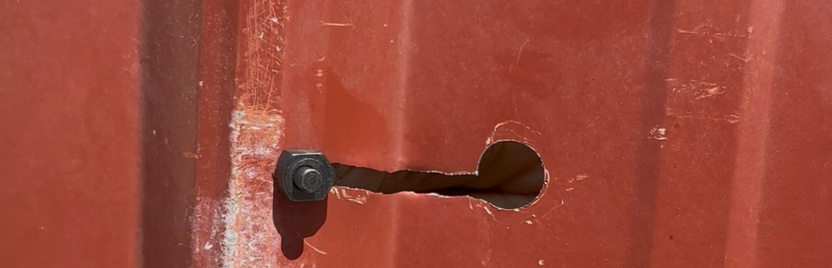
If you've ever needed to cut a vent, pipe pass-through, or any kind of interior opening in a corrugated metal panel, you already know the problem: most tools can't start a cut in the middle of a sheet. Tin snips work fine on the edge, but they can't punch in. Jigsaws bind in the corrugations. Circular saws throw sparks and leave chewed-up burrs. What you actually need is a way to cut corrugated metal in any direction, straight, curved, or anywhere in between, without a fight.
That's exactly what the Bad Dog Biter does. With one starter hole and the Biter chucked in your drill, you can cut a clean opening anywhere on the panel. Here's the two-step method.
Why Cutting Corrugated Metal Is Harder Than It Looks
Corrugated panels aren't flat steel. The ridges flex, vibrate, and grab any blade that isn't built for them. Standard metal-cutting tools have their place. But most of them are made for edge cuts, not interior cutouts.
- Tin snips and aviation shears can't start a cut in the middle of a panel
- Jigsaws want to bind on the ribs, especially on tight curves
- Circular saws with metal-cutting blades are loud, throw hot sparks, and leave rough burrs that need cleanup
- Angle grinders work but heat the panel and can damage galvanized coatings
The Bad Dog Biter solves it differently. It chucks into any standard drill, drops into a 1/2" starter hole, and rolls through the metal as you guide it. Flat sheet, ridges, curves, none of it stops the bit.
The 2-Step Method: Starter Hole Plus Biter
Here's the whole process in one breath: drill a 1/2" hole, drop the Biter in, cut. That's it. Once the Biter is seated in the starter hole, you can go in any direction you want to go. You can cut straight lines, tight curves, and full circles for round openings.
The starter hole has to be a clean 1/2". That's where the Bad Dog Stubbies come in.
Step 1 — Drill a 1/2" Starter Hole With a Bad Dog Stubby
The Stubby is a short cobalt step bit. Drop it in your drill, line up where you want the opening, and step it up to 1/2". Done.
A few reasons the Stubby is the right bit for this job:
- Short profile — fits in tight spots where a standard-length step bit can't reach
- Cobalt construction — built to handle steel, stainless, and other tough materials
- Locking extensions — when you do need length, you get it without sacrificing rigidity
- One bit, multiple sizes — useful for the rest of the job too, not just this one hole
Mark your spot, support the panel from underneath, drill straight through to the 1/2" step. You'll have a clean entry point ready for the Biter.
Step 2 — Drop the Bad Dog Biter in the Hole and Cut
Pull the Stubby out, swap in the Biter, drop it into the hole. The Biter rolls right in. From there, you guide the cut. Straight, curved, anywhere on the panel.
A few things worth knowing about the Biter:
- Under one pound — it doesn't fight you, so you can run long cuts without your arm giving out
- Roughly 2,000 feet of cutting per blade set on 18-gauge mild steel — a lot of corrugated panel before you swap blades
- Cuts in any direction — no need to back out and re-enter for curves
- Standard drill chuck — no special tools, no special drill, just chuck it up
The Biter doesn't care which way you go. Trace your cut line and follow it.
Quick Reference: What You Need for the Job
For interior cutouts in corrugated metal:
- Bad Dog Stubby step bit — drills the 1/2" starter hole
- Bad Dog Biter — does the cutting
- A standard drill, corded or cordless
- A marker to lay out your cut line
- Something to support the panel from underneath
Pro Tips for Cutting Corrugated Metal
- Mark your line first. Don't freehand it. A clear line gives the Biter something to follow and saves you from creeping off-course.
- Support the panel. Corrugated metal flexes. A bit of support under the cut zone keeps the panel from chattering and gives you a cleaner result.
- Slow down on tight curves. The Biter will go where you point it, but it works best with steady pressure rather than forced direction changes.
- Let the tool pull itself along. Don't muscle it. Keep the bit seated and let it track through the metal.
- Wear gloves. Cut metal edges are sharp until you deburr them.
Ready to Cut Corrugated Metal the Easy Way?
The Bad Dog Biter and Bad Dog Stubbies are made in Bristol, Rhode Island, the same way they have been since 1988 — and every Bad Dog tool is backed by a lifetime guarantee. If a bit fails, we repair or replace it.
Questions? Call 800-252-1330
Frequently Asked Questions
What's the best tool to cut corrugated metal?
For interior cutouts — vents, pipe pass-throughs, fixtures — the Bad Dog Biter is hard to beat. It chucks into a standard drill, drops into a 1/2" starter hole, and cuts in any direction. For straight edge cuts only, tin snips or aviation shears can work, but they can't start a cut in the middle of a panel.
Do you need a starter hole to cut corrugated metal?
For interior cuts, yes. The Bad Dog Biter needs a 1/2" starter hole to drop into before it can begin cutting. A Bad Dog Stubby step bit drills the hole in seconds. For edge cuts only, you can skip the starter hole and run snips or shears in from the side.
Can you cut curves in corrugated metal?
Yes. Once the Bad Dog Biter is seated in the starter hole, you guide it freehand, straight, curved, or full circles. That's the whole point of the tool: cut in any direction without stopping, backing out, or re-entering the panel.
What size starter hole does the Bad Dog Biter need?
A 1/2" hole. Anything smaller and the Biter won't drop in cleanly; anything bigger and you've made unnecessary work. The 1/2" step on a Bad Dog Stubby step bit drills it fast.
Will the Bad Dog Biter cut other metals besides corrugated?
The Biter is rated for roughly 2,000 feet of cutting per blade set on 18-gauge mild steel. It handles flat steel sheet, aluminum, and similar gauges as well. For thicker plate or hardened steels, the Bad Dog team can point you at the right tool — topdog@baddogtools.com or 800-252-1330.
Written by Joseph Strong on 6th May 2026 I’m JJ Strong, a mechanical engineer and third-generation tool designer at Bad Dog Tools, our American-made, family-run company built on durability and innovation. I grew up hauling booths and talking tools at trade shows before I could even drive. Now I design and build and improve our next generation of lifetime-guaranteed tools - our custom induction brazing system to our precision sharpening technology. On weekends, you’ll find me restoring my ’86 Land Rover Defender or ’54 Jaguar XK120 and seeing just how much I can build (or break) with Bad Dog Tools.