








The step bit built for spots you cant get to
Stubby Step Drill Bits That Actually Fit Where You Need to Work
There’s always that one spot. The torque box you’re trying to drill out on a Mustang restoration. The engine bay corner that’s 4 inches from the nearest flat surface. The ductwork run that was clearly installed before anyone thought about future repairs. Standard step bits can do the job — but only if you can get them into position. When you can’t, you need stubby step drill bits built for exactly that situation.
The Bad Dog Stubbies are the same cobalt step bits we’ve been making since 1988, just in the shortest possible drilling profile. Same self-centering tip. Same capability to stop clean at any step size. Same lifetime guarantee. Just designed to stay as close to your drill as physically possible so you can work in spots where nothing else fits.
Why Standard Step Bits Can’t Always Get the Job Done
The problem isn’t the bit — it’s the length. A standard step bit with a full-length shank sticks out 4, 5, 6 inches from your chuck before you’ve even started drilling. In open space, that’s no issue. In a confined area, that extra length turns into a clearance problem. You end up fighting the geometry of the job instead of drilling the hole.
That’s especially true in auto body and restoration work, where you’re constantly reaching into rocker panels, torque boxes, structural channels, and other enclosed areas that weren’t designed with drill access in mind. HVAC and sheet metal work has the same problem — ductwork runs and tight corners that leave you with no room to maneuver.
How Stubby Step Drill Bits Change Your Clearance Math
Short shanks mean the bit sits much closer to your drill. The Bad Dog Stubbies range from 1-5/8″ to 2-1/4″ in length depending on the size — compared to standard step bits that can run 3–5 inches. That difference is often the margin between a hole you can drill and one you can’t.
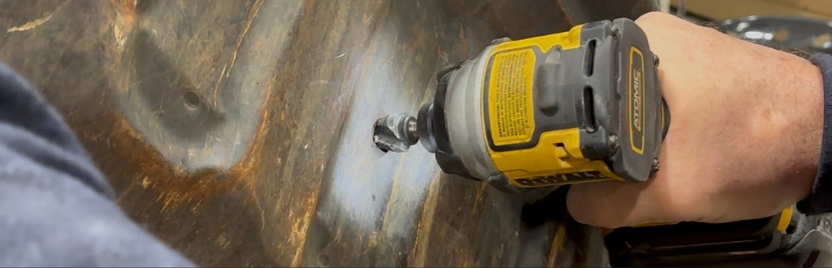
The bits use the same quick-connect hex shank as our full-size step bits, so they drop straight into an impact gun or standard drill with no adapter needed. The self-centering stepped tip means you don’t need a center punch to start — just position, press, and go. And because each step cuts a clean, precise hole in sheet metal, you can stop at any diameter along the way.
What’s in the Bad Dog Stubbies Set
The set includes four cobalt step bits covering a comprehensive size range, plus three locking extensions:
| Bit | Size Range | Steps | Length |
|---|---|---|---|
| 1 | 1/8″ – 3/8″ | 5 | 1-5/8″ |
| 2 | 1/8″ – 1/2″ | 7 | 1-3/4″ |
| 3 | 3/16″ – 5/8″ | 8 | 2-1/8″ |
| 4 | 1/4″ – 3/4″ | 9 | 2-1/4″ |
The extensions: 2.5″, 4″, and 6″ locking extensions — stack to 12.5″ total reach. The extensions lock together and attach to any bit in the set. So you’re not choosing between tight-space access and deep-reach capability — you’ve got both covered with the same set.
QUICK REFERENCE
Max size: 3/4″ | Total steps: 29 | Extensions: 2.5″, 4″, 6″ (stackable to 12.5″) | Shank: quick-connect hex | Impact gun compatible | Made in USA | Lifetime guarantee
How to Use the Stubbies in a Tight Spot
- Choose your bit based on the hole size you need. The 1/4″–3/4″ bit handles most common applications; the smaller bits are for light-gauge work and starter holes.
- Add an extension if needed. The 2.5″ extension is usually enough for shallow confined areas. Stack the 4″ and 6″ to reach deep into a channel or structural cavity.
- Lock everything together — the hex-lock connection means no wobble, no slippage mid-hole.
- Drop it into your impact gun for high-RPM applications. Step bits need speed to cut effectively, and the impact gun delivers.
- Position the self-centering tip and apply steady pressure. No center punch required.
- Stop at your target step — back off the trigger when you hit your diameter. Or run it through if you’re drilling a clearance hole.
Pro Tips
Stack your extensions before you commit to the spot. It’s easier to reconfigure before you’re elbow-deep than after.
Use the smallest bit that covers your range — the shorter shank on the 1/8″–3/8″ bit gives you even more clearance for ultra-tight corners.
The Stubbies pair well with a full set. Keep the full Bad Dog step bit set for open work, and reach for the Stubbies when geometry forces your hand.
BAD DOG STUBBIES
Short Cobalt Step Bit Set with Locking Extensions · Made in USA since 1988 · Lifetime Guarantee
Four cobalt step bits up to 3/4″, plus 2.5″, 4″, and 6″ locking extensions. If it dulls or breaks, we repair or replace it — for life.
SHOP THE STUBBIES →800-252-1330 | topdog@baddogtools.com
Frequently Asked Questions
What sizes do the Bad Dog Stubbies drill?
The set covers 1/8″ through 3/4″ across four bits, with 29 total steps. The four bits are: 1/8″–3/8″, 1/8″–1/2″, 3/16″–5/8″, and 1/4″–3/4″. Between the four bits you’ve got virtually every common hole size in sheet metal work covered.
Can I use the Stubbies with an impact gun?
Yes — the quick-connect hex shank is fully impact-compatible. Step bits benefit from high RPM, so an impact driver is actually a solid choice for sheet metal drilling with these.
Do I need a center punch to use step bits?
No. The self-centering stepped tip finds its own starting point without a punch. Just position it where you want the hole and apply pressure.
How do the locking extensions work?
The 2.5″, 4″, and 6″ extensions connect to each other and to any bit in the set using a hex-lock connection. Stack all three for up to 12.5″ of total reach. They lock so there’s no wobble or flex during drilling.
What’s the difference between the Stubbies and the standard Bad Dog step bit set?
The bits are the same — same cobalt construction, same self-centering tip, same cutting geometry. The Stubbies are just shorter (1-5/8″ to 2-1/4″) to maximize clearance in tight spots. If you’re mostly drilling in open space, the full-size set works great. The Stubbies are for when you can’t get a standard bit into position.
Written by Joseph Strong on 15th Apr 2026 I’m JJ Strong, a mechanical engineer and third-generation tool designer at Bad Dog Tools, our American-made, family-run company built on durability and innovation. I grew up hauling booths and talking tools at trade shows before I could even drive. Now I design and build and improve our next generation of lifetime-guaranteed tools - our custom induction brazing system to our precision sharpening technology. On weekends, you’ll find me restoring my ’86 Land Rover Defender or ’54 Jaguar XK120 and seeing just how much I can build (or break) with Bad Dog Tools.