








Are your fingers safe with the Bad Dog Biter?
The first thing people notice about the Bad Dog Biter is the cutting head, and their first instinct is to keep their fingers away from it. That's a reasonable reaction. You've been trained by grinders, shears, and torches to treat cutting tools with serious respect. But the Biter isn't built like those tools, and the safety rules aren't the same. Understanding how it actually cuts changes everything.
Why Most Sheet Metal Tools Feel Dangerous (Because They Are)
Grinders throw sparks and can kick back. Torches deal in open flame. Aviation shears require real force and leave sharp edges that can slice you on cleanup. These tools demand constant attention to where your hands are, because the danger zone is the entire cutting surface.
That's the mental model most people bring to the Biter. And it's the wrong one.
How the Bad Dog Biter Actually Works
The Biter doesn't cut like a grinder or a set of shears. Its cutting mechanism is built around a specific geometry: material only gets cut when it passes between the cutting head and the pin.
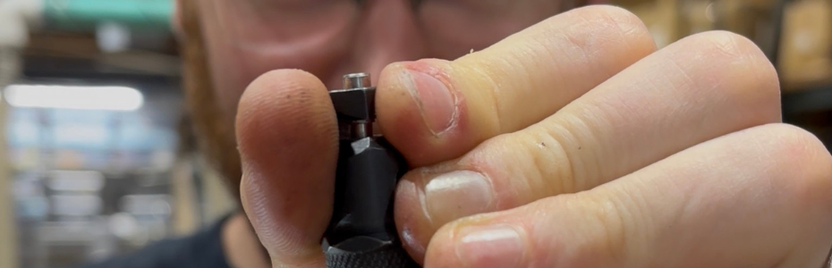
That's the whole system. If material isn't in that narrow gap, it isn't getting cut. The fatty part of your finger is physically too large to fit between the cutting head and the pin. It cannot enter the cutting zone.
JJ Strong demonstrates this on camera — fingers resting directly on the cutting edge, zero risk. That's not bravado. That's geometry.
What This Means for How You Work
When you're not afraid of the tool, you work differently. You get closer. You're more precise. You make the cut you actually want instead of the cut you can safely reach from a distance.
The Biter's patented steerable head is designed for exactly that kind of precision, guiding the cut where you need it, not where the tool pushes you. That level of control simply isn't possible with a grinder or a torch, where keeping your hands at a safe distance is non-negotiable.
With the Biter, your hands can be exactly where they need to be.
The Biter vs. the Alternatives
Here's the honest comparison:
The Biter isn't for every job. But for sheet metal work where precision and safety both matter, it removes tradeoffs the other tools force on you.
Try It Yourself
The best way to understand the Biter is to put your fingers on the cutting edge — something we actually encourage. Backed by our lifetime guarantee. Made in the USA since 1988.
See the Bad Dog Biter →Questions? Call 800-252-1330 or email topdog@baddogtools.com
Frequently Asked Questions
Can the Bad Dog Biter actually cut my fingers?
No, and this isn't just a safety claim, it's a mechanical one. The Biter only cuts material that enters the gap between the cutting head and the pin. Your fingers are too large to fit into that zone. You can rest your fingers on the cutting edge with no risk of injury.
How does the Biter compare to using an angle grinder for sheet metal?
The Biter is slower than a grinder but far safer, lighter (under one pound), and produces no sparks. It's the better choice for precision cuts or work in tight spaces where a grinder would be dangerous or impractical.
What gauge sheet metal can the Bad Dog Biter cut?
The Biter is designed for sheet metal work and handles 18-gauge mild steel, delivering approximately 2,000 feet of cutting per blade set.
What is the steerable head on the Bad Dog Biter?
The Biter features a patented steerable cutting head that lets you guide the direction of your cut with precision. Unlike shears that lock you into a path, you can maneuver the Biter through curves and angles without losing control.
Does the Bad Dog Biter require special safety equipment?
No sparks, no flame, no kickback. Standard work gloves are recommended as with any metal cutting. The cut edges of sheet metal are sharp, but the tool itself eliminates the major hazards that make grinders and torches require full PPE.
Written by Joseph Strong on 24th Jun 2026 I’m JJ Strong, a mechanical engineer and third-generation tool designer at Bad Dog Tools, our American-made, family-run company built on durability and innovation. I grew up hauling booths and talking tools at trade shows before I could even drive. Now I design and build and improve our next generation of lifetime-guaranteed tools - our custom induction brazing system to our precision sharpening technology. On weekends, you’ll find me restoring my ’86 Land Rover Defender or ’54 Jaguar XK120 and seeing just how much I can build (or break) with Bad Dog Tools.