








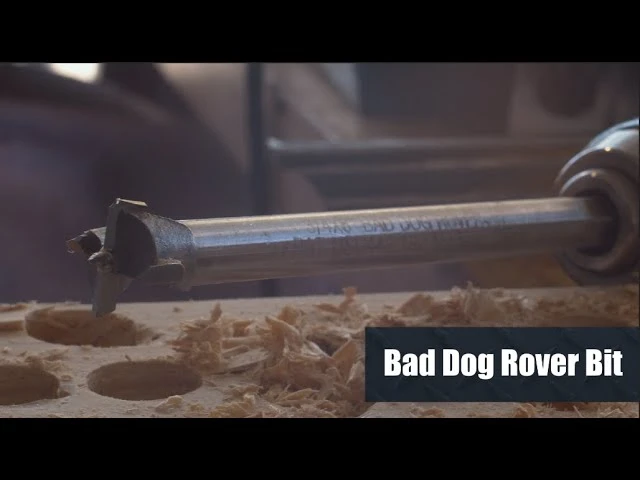
Rover Bits How To
THE BASICS
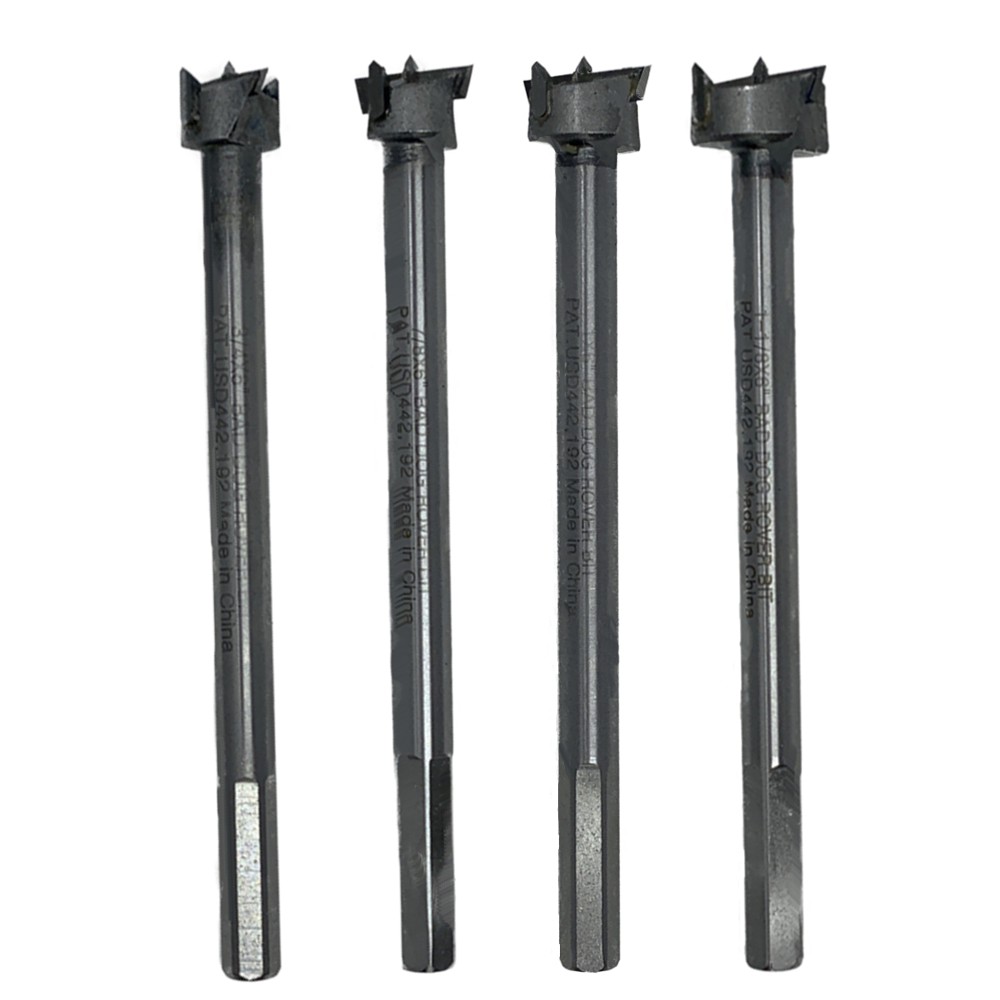
The Bad Dog Rover Bit is an aggressive bit — faster than a spade or paddle bit — and will cut at any speed from 400 to 2,500 RPM. If you are drilling around corners make sure to never drill towards yourself. If you run into any issues, please read on or call us at 1.800.252.1330.
Drilling Speeds & Specifications
| MATERIAL | SPEED |
|---|---|
| Wood & Wood Composite | 400–2,500 RPM |
| Particle Board | 400–1,500 RPM |
| Carbon Fiber | 400–1,000 RPM |
| Fiberglass | 400–1,500 RPM |
| Solid Surface (Corian) | 800–1,000 RPM |
SPECIFICATIONS
Power Source: 1/2″ or 3/8″ Electric Hand Drill
Shank: Hex end for non-slip drilling
Minimum RPM: 400
Maximum RPM: 2,500
Note: Lower speed allows for more control.
What Can I Drill?
Wood
The Rover Bit makes quick work of all woods, hard and soft. It leaves clean flat bottom holes.
Plastics / PVC
From PVC board to composite decking, the Rover Bit makes short work of plastics.
Fiberglass
Rover Bits drill clean holes in fiberglass with minimal blowout on the reverse. Always wear a mask when cutting fiberglass with any tool.
Corian / Solid Surface
Rover Bits are excellent for installing sinks and hardware in solid surface countertops, drilling quick clean holes.
Carbon Fiber
Because they use the same carbide as our Multipurpose Drill Bits, Rover Bits drill more holes in carbon fiber than other Forstner or paddle bits — leaving clean holes without blowout.
Melamine
Rover Bits excel in melamine. Their side cutters bore through the surface coating quickly and cleanly.
What Can’t I Drill?
Metal
The tips of a Bad Dog Rover Bit are too aggressive to cut metal and will fracture if you try. A Rover Bit can in some cases cut through nails encountered in another material, but nails should always be avoided — even if the bit gets through, there will almost always be damage done in the process.
Stone
Like metal, stone is too hard for the Bad Dog Rover Bit. Even soft stones or concrete can have aggregate that will chip and fracture the bit.
Tile
Tile will dull or chip a Rover Bit, especially hard tile like porcelain or glass.
Advanced Tips
MATCH YOUR SPEEDS AND FEEDS
Push harder when drilling fast to prevent burning the material. When drilling more slowly, use less pressure to prevent the bit from binding up in the material.
ALWAYS SET THE POINT BEFORE YOU SPIN
Always set the point and start drilling before turning the bit in the material. Never start drilling with the bit on an angle — the side cutters should never contact the material before the center point or the bit will try to ‘walk’ across it.
THE BIT TELLS YOU WHEN IT’S DULL
The bit will let you know when it’s dull by cutting more slowly and burning the material. Sharpening is covered by your lifetime guarantee — send it back to us and we’ll get it taken care of for you.
DRILLING NEAR EMBEDDED NAILS
If you’re drilling anything that could have an embedded nail, spin the bit at least 2,000 RPM. While the bit is capable of drilling through nails, it’s not healthy for it long term. Never start on top of a nail, and if you know there’s a nail in your path, avoid it. If you do come across a nail, don’t try to change the direction of the bit mid-cut.
Built to Bore. Guaranteed for Life.
The Bad Dog Rover Bit cuts faster than a spade or paddle bit in wood, plastics, fiberglass, carbon fiber, solid surface, and melamine. Made in the USA since 1988 and backed by our lifetime guarantee — if it ever fails to perform, we sharpen or replace it.
LESS BARK. MORE BITE.
800-252-1330 · baddogtools.com
Written by Joseph Strong on 5th May 2026 I’m JJ Strong, a mechanical engineer and third-generation tool designer at Bad Dog Tools, our American-made, family-run company built on durability and innovation. I grew up hauling booths and talking tools at trade shows before I could even drive. Now I design and build and improve our next generation of lifetime-guaranteed tools - our custom induction brazing system to our precision sharpening technology. On weekends, you’ll find me restoring my ’86 Land Rover Defender or ’54 Jaguar XK120 and seeing just how much I can build (or break) with Bad Dog Tools.